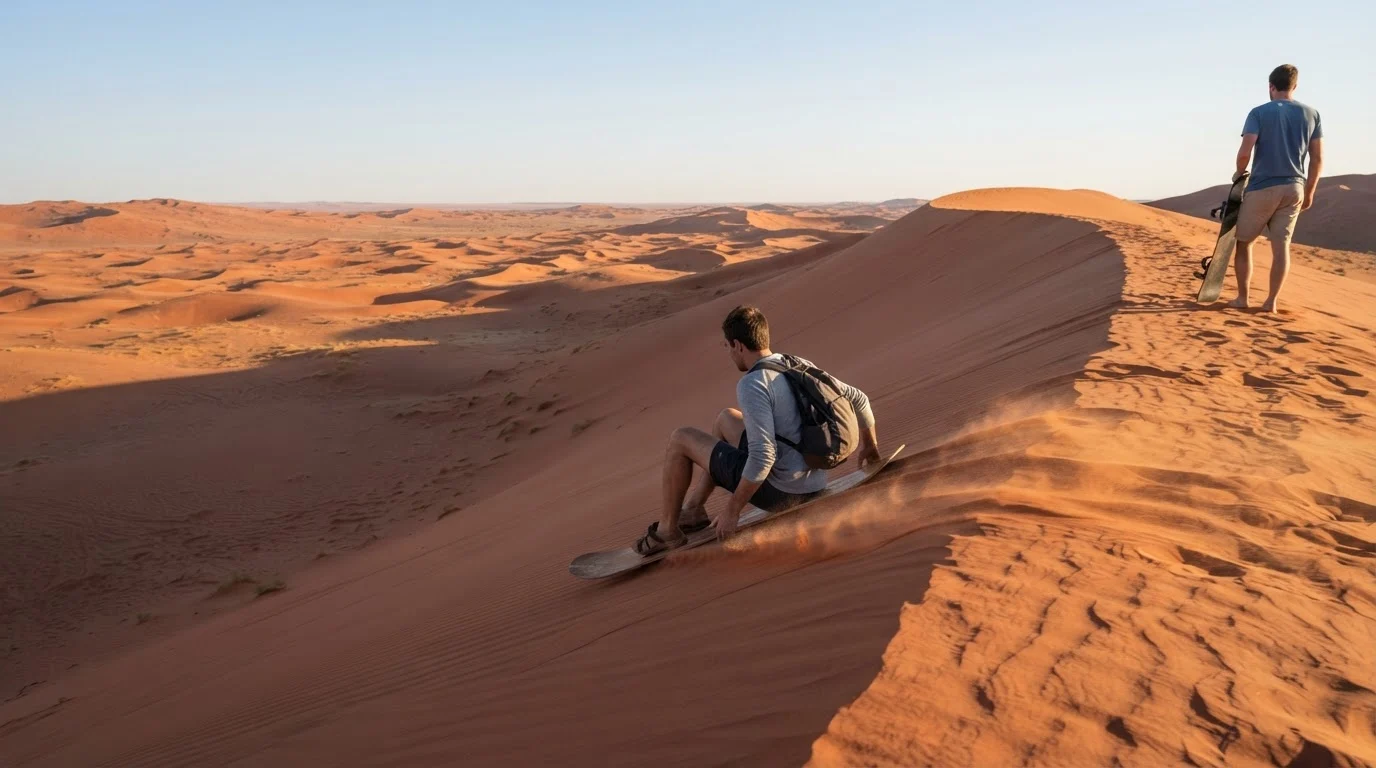
Yes, sandboarding in Dubai is one of the gentler desert activities for a beginner, provided you start seated on a gentle slope, go feet first and take the walk back up at your own pace. With Al Qudra Tours, sandboarding costs AED 50 per person and is added to a buggy or quad booking.
Key takeaways
- Sandboarding with Al Qudra Tours costs AED 50 per person and is added to a buggy or quad booking on the activities booking form.
- A first run is normally done sitting down, feet first, on a short and gentle slope. Standing up comes later, once the seated runs feel controlled.
- There is no lift on a dune. Every run ends with a walk back up through loose sand, and that climb is the most tiring part of the activity.
- The shared safari package descriptions do not list sandboarding, so ask the team before booking if you want it on a safari day.
- Pregnant guests are asked to skip buggy and quad rides, and guests with back injuries or recent surgery skip dune bashing. Declare any medical condition when you book.
- Buggy, quad and safari prices do not include hotel pickup. Add a sharing transfer at AED 175 per person, a private car at AED 450 for 5 to 6 guests, or meet at the location sent to you by email.
Is sandboarding safe for beginners?
Sandboarding means riding a board down a slope of sand, sitting or standing. For a first-timer it is one of the most low-key things to do in the Dubai desert: no engine, no throttle and no steering wheel.
How safe it feels depends on four things you control:
- The slope. A short, smooth slope with a soft, flat run-out at the bottom is the right place to start. A long, steep face is not.
- Your direction. Feet first gives you a view of where you are going and a way to slow down. Head first, lying on your stomach, gives you neither.
- Your timing. Standing up before the seated runs feel easy is the usual way beginners end up tumbling.
- Your energy. The climb back up takes effort, and people get careless on the run they take when they are already tired.
Sand is softer to land on than ice or hard-packed snow, which is why sandboarding appeals to people who have never tried a board sport. Soft is not harmless, though. Sand is abrasive, it gets into eyes and pockets, and an awkward fall on a steep face can still jar a wrist or a knee. Treat it as a gentle activity done carefully.
Where sandboarding fits in an Al Qudra Tours day
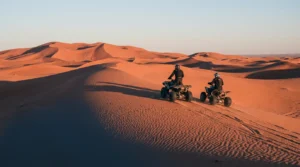
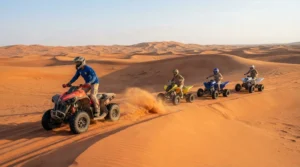
Al Qudra Tours runs its buggies, quads and the KTM dirt bike from a staging area near the Al Qudra dune zone. Sandboarding is added to a buggy or quad booking, so it belongs to the same day as your ride. The ride follows a set format: a briefing, then a helmet, goggles and gloves, then a convoy behind a lead guide with a sweep guide at the back. The team confirms how sandboarding fits around that ride on your date.
How does sandboarding work?
Sandboarding works on the same principle as sledging down a snowy hill. Gravity pulls the board down the slope, and you use your weight to steer and to slow down. The difference is the surface. Sand has more friction than snow, so a board moves more gently and stops sooner once the ground flattens out.
The seated first run
Almost every beginner should start sitting down. It is the easiest way to learn how the board reacts to the sand, and you are already close to the ground if you tip over.
- Sit towards the back of the board with your legs stretched forward.
- Hold the sides or the front edge of the board with both hands.
- Lean back slightly to keep your weight off the nose.
- Shuffle forward with your hands until the board tips over the edge of the slope.
- To slow down, press both heels into the sand in front of you. To turn a little, press one heel harder than the other or lean to that side.
- At the bottom, let the board stop on its own on the flat sand before you stand up.
Keep your hands on the board rather than trailing them in the sand at your sides.
Standing up when you feel ready
Standing sandboarding is closer to snowboarding or skateboarding. You stand sideways on the board with one foot forward, knees soft, arms out for balance and eyes on where you want to go. Your weight stays slightly on the back foot so the nose does not dig in.
On sand, a standing board usually needs a small push to get going, and it slows quickly where the slope eases off. Turning takes more effort than on snow, so beginners usually ride a straight line down a gentle face at first.
Expect to fall. When you feel yourself going, sit back towards the slope and let your seat take the landing, rather than reaching out with a straight arm. Pitching forward over the nose is the fall to avoid, which is another reason to keep your weight back.
Choosing a gentle slope
The slope matters more than anything else on a first session. Look for:
- a short face where you can see the whole run, top to bottom
- a smooth surface without sharp ridges, holes or tyre tracks across it
- a flat or gently rising area at the bottom where the board can stop by itself
- nobody walking up or standing in your line
If a slope looks steep from the top, it is too steep for a first run.
Walking back up
After every run you carry the board back up on foot. Climbing loose sand takes more effort than walking uphill on a path, because each step slides back a little. A few habits help:
- climb in a zigzag rather than straight up the face
- step into the footprints of the person ahead of you
- carry the board under one arm, or drag it behind you by its front edge
- stop at the top, drink some water and get your breath back before the next run
For most beginners the climb, not the slide, decides how many runs they manage. Pace yourself and stop while you are still enjoying it.
Is sandboarding hard?
Sand boarding, as it is sometimes written, is not hard in its seated form. If you can sit on a sledge, you can do a seated run on a gentle slope on your first try.
Standing is a balance skill that takes a few attempts. People who surf, skate or snowboard usually stand up sooner, because the stance feels familiar. Others may need several falls before a standing run feels controlled, and some happily stay seated all session.
The physical side is mostly the walking. Pushing up loose sand works the legs and lungs, and in the warmer part of the day the sand can get very hot to touch, so keep the session short and the water bottle close.
If you are also wondering how much the buggy, quad or dirt bike part of the day asks of your body, the guide on how physical a buggy, quad or dirt bike ride is covers each machine in turn.
Sandboard vs snowboard: what carries over
If you have snowboarded before, you will recognise the basics. The table compares the two in general terms.
| Sandboarding | Snowboarding | |
|---|---|---|
| Surface | Loose sand with more friction | Packed snow or powder with less friction |
| Getting back up | Walk up the dune with the board | Usually a lift or tow |
| How the board moves | Gentler glide, stops sooner on flat ground | Faster glide, carries speed further |
| Turning | Harder, as edges grip sand less | Easier, as edges carve into snow |
| Landing a fall | Softer, but sand gets everywhere | Harder on packed snow or ice |
| Clothing | Light, covering clothes and sun protection | Warm layers, gloves and goggles |
| A typical first try | Seated, feet first | Standing from the start |
Stance, balance and keeping weight off the nose all transfer. The lift, the speed and the easy turning do not, and the climb back up is new to almost everyone.
What does sandboarding cost with Al Qudra Tours?
On the Al Qudra Tours activities booking form, sandboarding appears as SandBoarding at AED 50 per person, added to a buggy or quad booking. You choose the ride first, then add sandboarding for each person in the group who wants a board.
The table sets the sandboarding price beside the 30 minute buggy and quad options on the same form, plus the transfers. Each line is a separate price with its own unit.
| What you book | Length | Price | Unit |
|---|---|---|---|
| SandBoarding | Add-on to a buggy or quad | AED 50 | per person |
| Kids Quad Bike (90 CC, fenced area, recommended for ages 9 to 12) | 30 min | AED 150 | per quad bike |
| COBRA Single Seater Quad Bike (220 CC, fenced area, recommended for ages 14 to 17) | 30 min | AED 200 | per quad bike |
| Kymco Single Seater Quad Bike (open deep desert) | 30 min | AED 250 | per quad bike |
| Double Seater Quad Bike (one driver and one passenger) | 30 min | AED 350 | per quad bike |
| 2 Seater Polaris Dune Buggy RZR 1000 CC (self-drive) | 30 min | AED 600 | per buggy |
| 4 Seater Polaris Dune Buggy RZR 1000 CC (self-drive) | 30 min | AED 800 | per buggy |
| Sharing transfer (two or more guests from one pickup point) | Pickup 1 hour before the start | AED 175 | per person |
| Private transfer (5 to 6 guests) | Pickup 1 hour before the start | AED 450 | per car |
Watch the units: buggies are priced per buggy and quads per quad bike, while sandboarding and the sharing transfer are priced per person. Longer rides sit on the same form, for example the 2 Seater Polaris Dune Buggy RZR 1000 CC at AED 900 per buggy for 1 hour.
How sandboarding fits around a buggy, quad or safari booking
With a self-drive buggy
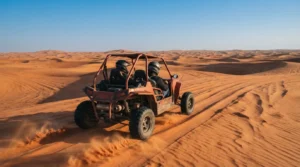
A 2 seater buggy carries the driver and one passenger, and a 4 seater carries the driver and three. The driver must be 18 or older and hold a driving licence from any country, shown as the physical card before the ride. Passengers do not drive, so a passenger who wants to try the board simply has sandboarding added at the per-person price.
In a mixed group, one person drives, the others ride along, and anyone can take a quieter turn on a board. The Dune Buggy Dubai page explains the buggy classes and the self-drive format in more detail.
With a quad bike
Quads are split by where they ride. The Kids Quad Bike, the COBRA and the SHARMAX ride in a fenced area. The Kymco, the Double Seater, the Yamaha, the Sports Quad and the Raptor 700 CC ride the open deep desert. Single seater quads carry one rider, and the Double Seater Quad Bike takes a driver and one passenger. Quad riders need no road licence for these rides.
If both the quad and the board are new to you, a 30 minute ride leaves more energy for the climbs afterwards. Read the quad biking for beginners page before you pick a machine.
With a desert safari
The shared Land Cruiser safaris are booked on a separate safari form. The Classic Evening Desert Safari With BBQ Dinner is AED 240 per adult (12+) and AED 225 per child (5 to 11), and covers a shared Land Cruiser, then the evening camp with a BBQ dinner and live shows. The Morning Desert Safari With Land Cruiser 4X4 is AED 225 per adult and AED 210 per child, with no dinner and no shows.
Neither package description lists sandboarding, and the versions with a 30 minute ATV quad bike session do not list it either. If you want to sandboard on a safari day, ask the team before you book rather than assuming it is part of the trip. The Desert Safari Dubai page sets out the morning, evening and private options.
Transfers and the meeting point
Buggy and quad prices do not include hotel pickup. You can add a sharing transfer at AED 175 per person (two or more guests from one pickup point) or a private car at AED 450 for 5 to 6 guests, with pickup 1 hour before the start. Or you can meet on site, and the location is emailed to you.
Start times on the booking form run from 5:00 AM to 8:00 PM, and the team confirms which slots run on your date. Rides run every day, but book a few days ahead for weekends and holidays.
What to wear and bring for a first run
Sand finds its way into everything, so dress for that rather than for photos. In general terms:
- Light, loose clothes that cover your arms and legs, to protect your skin from hot sand and sun.
- Closed shoes with socks that you do not mind filling with sand.
- Sunglasses with a snug fit, because blown sand is uncomfortable in the eyes. For the buggy or quad ride itself you are given a helmet, goggles and gloves.
- Sunscreen and a hat for the time spent waiting at the top.
- Water, to drink between runs.
- A zipped pocket for your phone and keys. Loose items fall out on a run and vanish into the sand.
- A spare top for the trip back.
Leave jewellery, loose scarves and anything valuable behind. For clothing advice season by season, see what to wear on a desert safari in Dubai.
Who should skip sandboarding or ask first?
Al Qudra Tours has written health rules for its rides:
- Pregnant guests are asked to skip buggy and quad rides.
- Guests with back injuries or recent surgery skip dune bashing.
- Guests declare medical conditions when booking.
- Adult riders sign a waiver.
Sandboarding is added to a buggy or quad booking, so these rules shape the day around it. The booking details do not set out a separate health rule for the board itself. If you are pregnant, have a back injury, have had recent surgery or live with any other condition, declare it when you book and let the team tell you what is possible for you. This guide gives no medical advice.
Children and sandboarding
No age for sandboarding is written into the booking details. Give the age of every child in your group when you book, and ask the team whether sandboarding suits them. The ages that are written down belong to other products: the shared safaris have a child rate for ages 5 to 11, the Kids Quad Bike in the fenced area is recommended for ages 9 to 12, and the COBRA Single Seater Quad Bike for ages 14 to 17.
A simple plan for a first sandboarding session
- Pick the ride first. Choose a buggy or quad and a ride length on the activities booking form.
- Add sandboarding. Add it for each person who wants to try.
- Sort the transport. Add a sharing or private transfer, or meet at the emailed location.
- Share ages and health. Declare medical conditions and give children's ages when you book.
- Listen to the ride briefing. Wear the helmet, goggles and gloves for the buggy or quad part of the day.
- Start seated and feet first. Use a short, gentle slope with a clear, flat run-out.
- Climb slowly. Zigzag up, rest at the top and drink water.
- Stand only when seated runs feel easy, and stop while it is still fun.
Booking, payment and cancellation
Bookings on the Al Qudra Tours forms are paid online by card in AED, and the confirmation is sent by email. The cancellation policy depends on how far ahead you cancel:
- 96 hours or more before departure: 95% refunded, as a 5% processing fee applies.
- 24 to 96 hours before departure: 50% refunded.
- Under 24 hours, or a no-show: no refund.
- Groups of 4 or more: 50% back 7 or more days ahead, and nothing at 5 days or less.
If the weather or the operator cancels, you get a refund less the 5% processing fee, or a free reschedule. Refunds go back to the original payment method within 30 days.
Ready for a first run on the sand?
Sandboarding is a calm way to try the desert on your own terms: start seated, keep to a gentle slope and let the climb set the pace. Choose your buggy or quad and add sandboarding on the Al Qudra Tours activities booking form. If you have a question about ages, health or a safari day first, call +971 50 496 8087 or email [email protected].