What's quad biking in Dubai actually like?
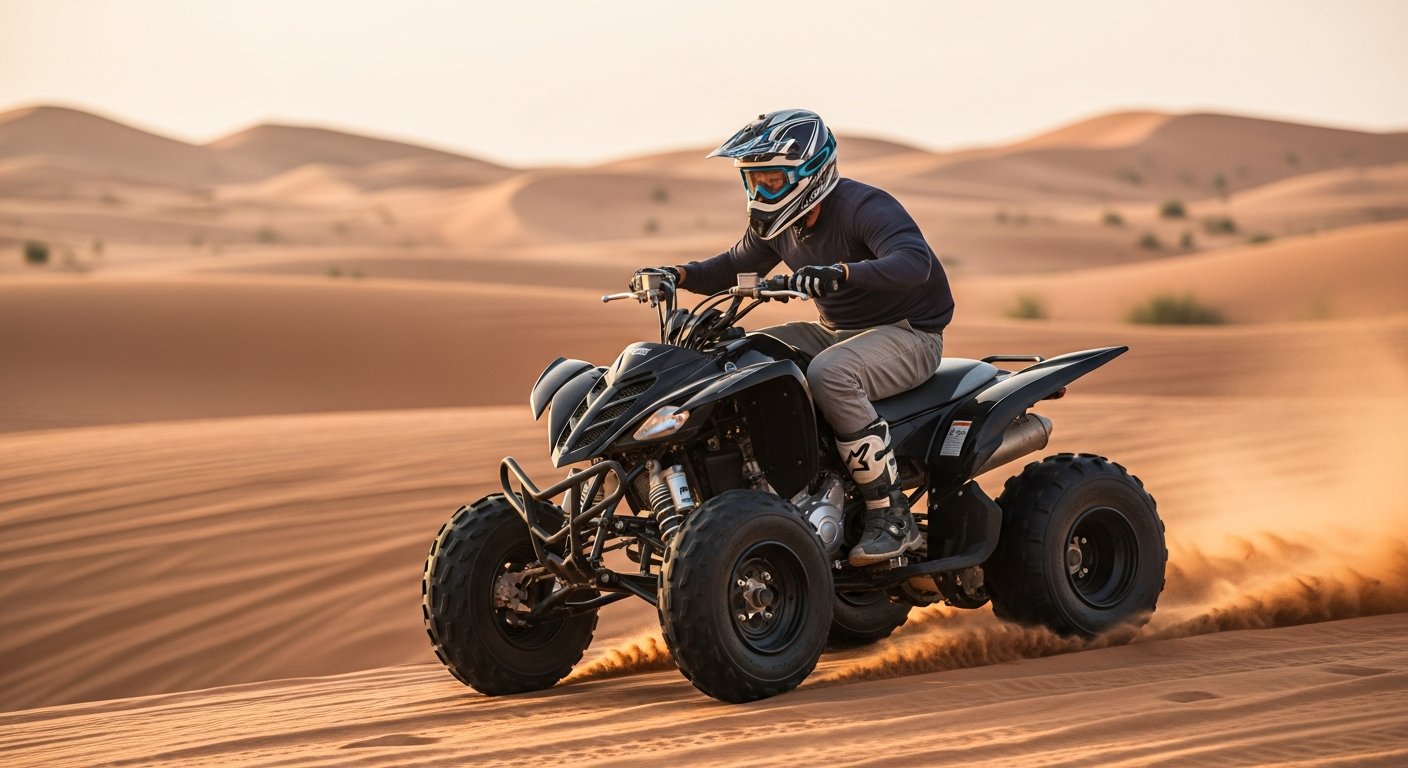
Quad biking in Dubai means straddling a four-wheeled ATV and following a guide in single file across open desert terrain, with the dunes rising and dropping under you the whole way. It's louder and rougher than a buggy ride, closer to the ground, and the engine vibration comes straight through the handlebars. A session runs as a guided loop, not a free-for-all, so you're never riding blind.
Most people booking this have never touched a quad bike before, and that's the real worry, not the sand or the heat. Will I stall it? Will I tip it on a slope? Al Qudra Tours handles that uncertainty the same way every time: a safety briefing before anyone starts the engine, protective gear handed out, and a guide who rides the route alongside the group rather than waving from a jeep. You follow the guide's line through the dunes, brake when they brake, and speed up when they open the throttle.
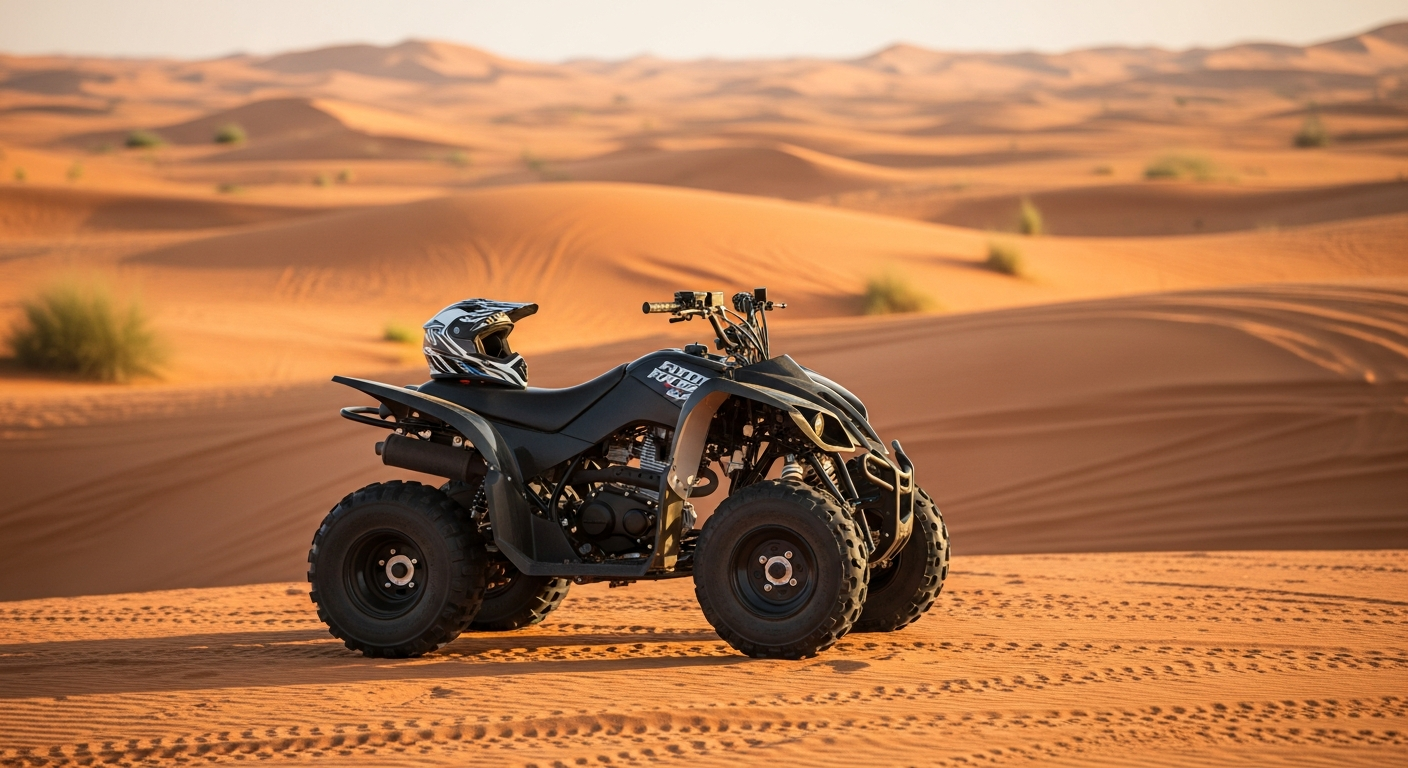
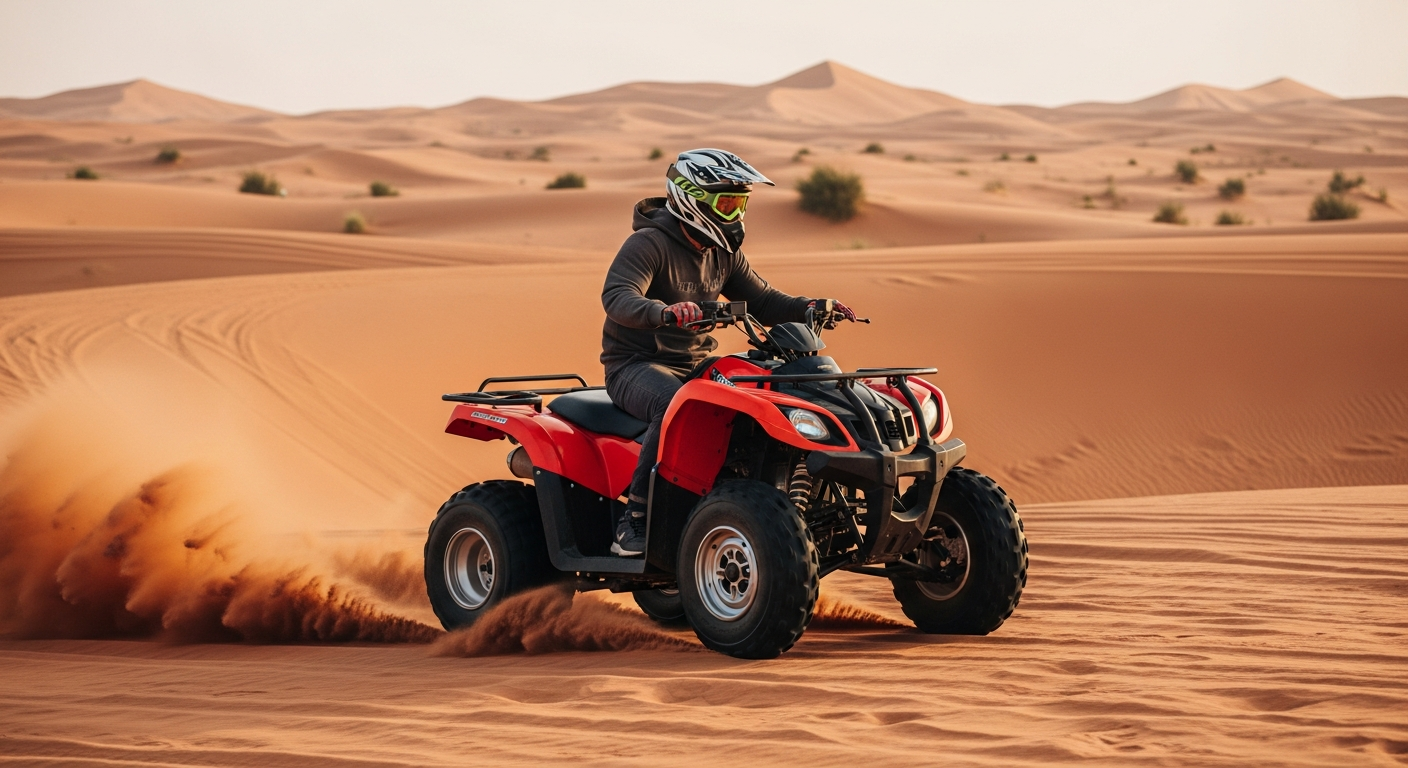
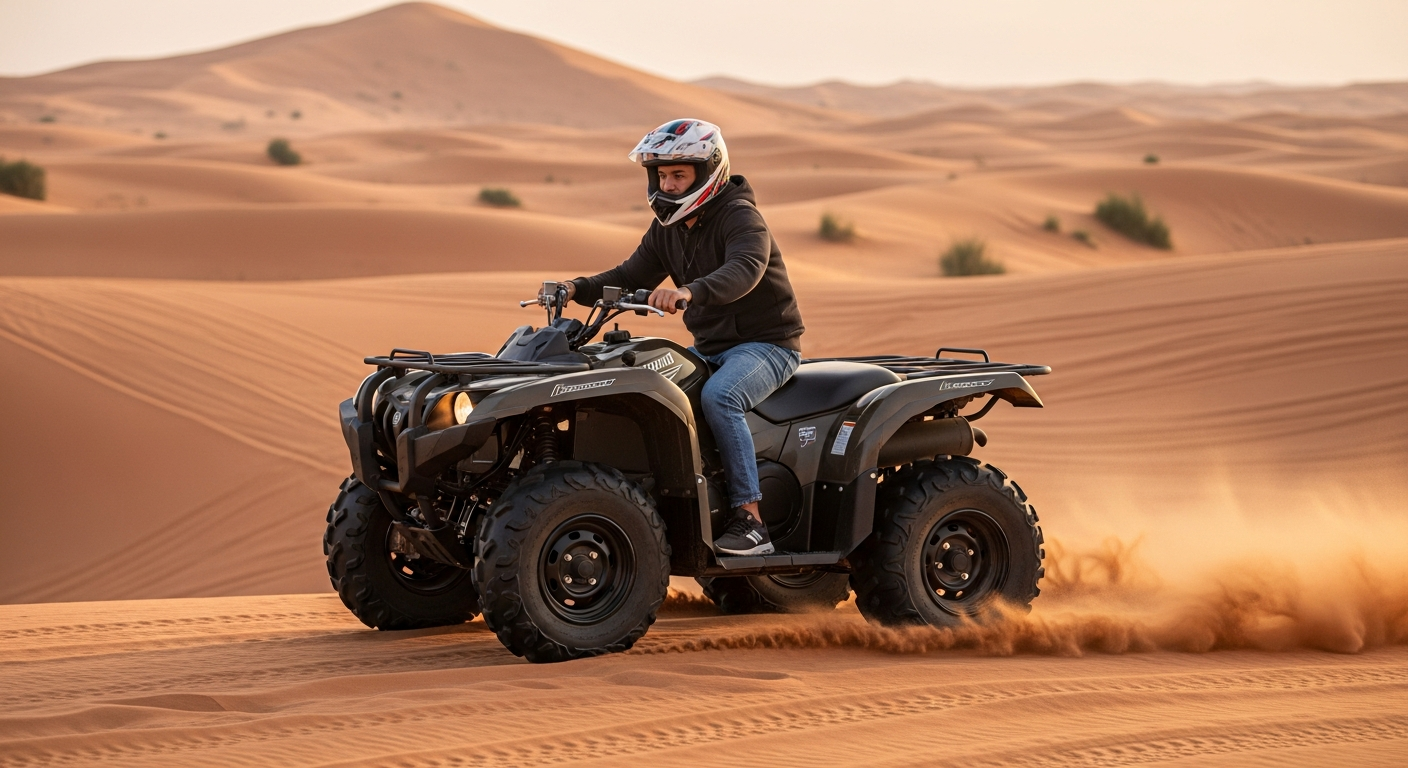
The route itself moves through a mix of flat compacted sand near the start and steeper dune faces further in, depending which package you booked. Riders on the entry-level single-seaters cover a shorter loop built around basic turns and moderate inclines. Anyone on the Yamaha Grizzly gets a longer stretch of track with sharper drops, because the bike has the torque to handle it. None of this is freestyle jumping or unsupervised racing across open dunes. It's controlled riding on a set path, with the guide setting pace for the whole group.
The desert outside Dubai's city limits looks nothing like the postcard shots of Downtown. It's wide open, quiet except for engines, and the sand shifts color from pale gold to a deeper red as you get further from the road. Sessions typically run in the cooler parts of the day, morning or late afternoon, when the sand holds together better and the ride is more comfortable.
By the end, riders who showed up nervous about handling a motor for the first time are usually the ones asking to go again. The bike does most of the balancing work on its own, and following a guide takes the guesswork out of navigation. What you're left with is a straightforward desert ride, dust on your clothes, and a decent workout in your arms and core from gripping the bars over uneven ground.
COBRA, Single Seater or Yamaha Grizzly - which quad should I pick?
Pick the COBRA or standard Single Seater if this is your first time on a quad, and pick the Yamaha Grizzly if you've ridden one before and want a longer, more technical route. The COBRA and Single Seater are effectively the same class of entry-level machine, both priced from AED 200, both built around a shorter guided loop that's easier to control at low speed.
Most people aren't stuck on price here. They're stuck on which bike matches their comfort level. Nobody wants to book the bigger bike and find out mid-ride that it's more machine than they can handle, and nobody wants to book the small one and feel like they paid for a golf cart. Al Qudra Tours splits the lineup so that choice is straightforward: COBRA and Single Seater for anyone new to quads, lighter riders, or people who just want a taste of dune riding without a steep learning curve. The Yamaha Grizzly sits above that with more torque and a bigger frame, built for a longer route that includes steeper dune sections and tighter technical turns.
In practice, the guide briefs everyone the same way regardless of bike, covering throttle control, braking, and how to read the guide's hand signals on the trail. What changes is what the machine can do once you're moving. The Grizzly holds its line better on loose sand at speed and climbs steeper faces without bogging down, which is why its route runs longer and covers rougher ground. The COBRA and Single Seater keep things simpler: enough power to enjoy the ride, not so much that a first-timer feels out of their depth.
If you're booking for a mixed group, this is usually where people get stuck. The answer is you don't have to match everyone to the same bike. Beginners can take the entry-level quads while more confident riders in the same group book the Grizzly, and the guide manages both paces within the session. Younger riders who don't fit any adult quad have their own 110cc option instead.
The short version: if you're unsure, start with the COBRA or Single Seater. It's the safer default, still gets you a real dune ride, and nobody's ever complained the beginner bike was too tame once they were out on the sand.
Can beginners or kids ride a quad bike?
Yes to both, but on different bikes. Beginners ride the COBRA or Single Seater quads, which are built for exactly that skill level, and younger riders take the Junior 110cc, a smaller machine kept at a controlled, supervised pace rather than the full guided loop adults ride.
The question usually comes from two directions: an adult who's never operated any motorized vehicle off-road and worries they'll embarrass themselves or get hurt, or a parent wondering if their kid can join instead of sitting out at the camp. On the adult side, nobody gets handed a quad and pointed at the dunes. Every rider, regardless of experience, sits through a safety briefing covering throttle, brakes, and how to follow the guide's lead before the engines start. The guide then rides the route with the group rather than sending people off alone, which is the part that settles most first-timers' nerves once they see it in practice.
For kids, the Junior 110cc is a separate, smaller bike, not a scaled-down version of the adult quads with the power dialed back. It runs at a controlled pace under direct supervision, built for younger riders who want the experience of riding their own bike without the speed or technical route that comes with the Grizzly or even the standard single-seaters. Parents typically book themselves onto a COBRA or Single Seater and their child onto the Junior 110cc, riding the same session as one group.
There isn't a single blanket age cutoff quoted here, since that's confirmed at booking depending on the child's size and the specific session, so the honest answer is to raise it directly on WhatsApp when you book and let the team match the right bike to the rider. That conversation takes a couple of minutes and avoids any surprise on arrival.
What this comes down to is that quad biking in Dubai isn't reserved for experienced off-roaders. The bikes and the route are matched to the rider, not the other way around, and the guide's job is as much about pacing beginners and kids as it is about leading anyone through the dunes. Most families who book a mixed group of adults and kids end up saying the Junior rider had as much fun as the grown-ups, sometimes more.
What's included, and is hotel pickup free?
Every quad biking package includes a safety briefing, protective gear, and a guide who rides the route alongside your group start to finish. That's consistent whether you've booked the COBRA, the Single Seater, the Yamaha Grizzly, or the Junior 110cc. Hotel pickup availability and any charge for it depend on your location and the specific session, so confirm that detail directly on WhatsApp when you book rather than assuming either way.
People asking this question are usually trying to work out the real cost before committing, not just the headline quad price. Nobody wants to book at AED 200 and then discover an unexpected transport charge on the day. The straight answer is that the ride itself, the safety gear, and the guide are locked in and included in every package quoted. Transport is the one variable that changes by where you're staying, so it gets sorted out in the same WhatsApp conversation where you pick your bike and time slot, before any payment is taken.
On the gear side, protective gear means the standard kit a rider needs before touching the throttle: a helmet fitted to your head, goggles or a visor against blowing sand, and guidance on grip and footwear if what you're wearing isn't suitable. The briefing that comes before it covers how the quad starts, throttle response, braking distance on sand, and the hand signals the guide uses on the trail so the group stays together without shouting over engine noise.
The guide riding alongside rather than trailing in a support vehicle is the part worth noting, because it's the difference between a supervised ride and a rental with a wave goodbye. If someone in the group stalls, drifts off the line, or needs to slow down, the guide is right there to adjust the pace for everyone, not radioing instructions from somewhere behind. That's the same setup across every tier, from a kid on the Junior 110cc to an experienced rider on the Grizzly.
So the practical version: bike, gear, briefing, and a guide riding with you are always in the price. Pickup is the one line item to confirm before you book, and getting that answer takes one message rather than a guess.
What should I wear, and how long does a session run?
Wear closed shoes, snug-fitting clothes you don't mind getting dusty, and bring something to tie back long hair or cover your face if the wind kicks up sand. A session runs as a single guided loop, from the safety briefing through to parking the bike back at the start point, and the length depends on which quad you've booked, since the Grizzly's route covers more ground than the entry-level machines. Confirm your exact slot and expected finish time on WhatsApp when you book.
Most people show up dressed for a photo, not a desert ride, which is the issue this question is getting at. Sandals slide off the footpegs, loose scarves catch on handlebars, and flip-flops offer nothing if a foot slips off the peg mid-turn. Al Qudra Tours hands out the protective gear that matters, helmet and goggles, but what you wear underneath is on you. Closed, laced shoes, trousers or at least longer shorts, and a top that covers your shoulders will get you through the ride without regretting it afterward.
Layering matters more than people expect. Mornings and evenings in the desert run cooler than the city center, and a light jacket or long sleeve over a t-shirt handles that without overheating once you're moving and the engine's warming you from below. Sunscreen and sunglasses under the goggles are worth packing too, since you're exposed the whole time, not riding inside a covered vehicle.
On timing, the session itself is built around the briefing first, then the ride. Nobody starts an engine before hearing how it handles, where the brakes are, and what the guide's hand signals mean. From there it's one continuous loop, shorter and simpler on the COBRA or Single Seater, longer and more technical on the Grizzly, with the guide setting the pace throughout so the group finishes together rather than spread out across the dunes.
The practical takeaway is to dress like you're doing something physical outdoors, because that's exactly what this is, and to ask for your specific start and finish time when you book so you can plan the rest of your day around it without guessing.
Is quad biking safe if I've never ridden before?
Yes. Quad biking here is built around first-timers, not against them, which is why every session opens with a safety briefing and puts a guide on the trail riding with the group rather than just in front of it. Protective gear is handed out before anyone touches a throttle, and the pace is set by the guide, not by whoever wants to go fastest.
The worry behind this question is usually specific: what if I stall it, what if I roll it on a dune, what if I can't keep up with the group. Those are reasonable things to picture before you've ever sat on a quad. The way Al Qudra Tours structures the session addresses each one directly. The briefing covers exactly how the throttle and brakes respond before you're moving, so stalling or overreacting on the gas is far less likely once you're riding. The guide alongside the group, rather than ahead of it, means someone is watching for a rider drifting off-line or losing confidence and can slow the whole group down in response, instead of everyone racing to keep up with a lead vehicle disappearing over the next dune.
Quads themselves are also more forgiving than they look. Four wheels planted on sand give a stable base that a two-wheeled bike doesn't have, and the entry-level COBRA and Single Seater are geared for control rather than raw speed, which is exactly the tradeoff a nervous first-timer wants. The routes on those tiers stick to flatter ground and gentler inclines for the same reason. Riders who want more of a challenge move up to the Yamaha Grizzly once they've got a session or two behind them, not on their first attempt.
What goes wrong on a ride, when it does, is almost always the same short list: someone grips the throttle harder than they mean to on a turn, or someone ignores the guide's signal to slow down. Both of those get caught in the briefing before they happen and corrected by the guide in the moment if they slip through anyway.
So the honest answer for someone who's never touched a quad bike is that this is close to the safest version of that first experience you'll find: supervised the entire way, geared to your skill level from the start, and paced by someone riding next to you rather than shouting instructions from a distance.
How does quad biking compare to a dune buggy?
A quad bike is a single rider straddling the machine like a motorbike, steering and balancing it yourself. A dune buggy is an off-road frame with a roll cage, bucket seats, and pedals, closer to driving a lightweight car than riding a bike. Both cover the same dunes with a guide, but the experience of controlling each one is completely different.
People land on this question because they're picturing one activity and don't realize the two machines actually work differently, and it isn't a marketing distinction. On a quad, your whole body is doing the work: leaning into turns, shifting weight over bumps, gripping the bars through vibration. It's a physical ride, closer to motocross than to driving. A buggy, by contrast, has you strapped into a seat with a steering wheel and pedals, so the ride is smoother in terms of body input even though the terrain underneath is identical sand and dunes.
That difference decides who each vehicle suits. Someone who wants to feel the bike respond to their own balance, who's ridden a motorbike or bicycle before and likes that kind of control, tends to prefer the quad. Someone who wants the thrill of speed and drops through the dunes without the physical demand of holding a bike upright often prefers the buggy instead. Buggies also work better if you want to ride two-up with a passenger sharing the seat, which isn't an option on any of the single-rider quads here, Grizzly included.
Cost and route length aren't directly comparable between the two, since the quad lineup at Al Qudra Tours runs from AED 200 on the COBRA and Single Seater up through the Grizzly, while buggy packages are quoted separately depending on the model. If you're weighing both, the practical move is to message the team on WhatsApp and describe who's riding, how many people, and what kind of ride you want, and get matched to whichever fits rather than guessing from a spec sheet.
Neither one is the objectively better choice. It comes down to whether you want to ride a machine with your body or drive one with your hands and feet, on the same stretch of desert either way.
How do I book, and what happens if the weather turns bad?
Booking runs through WhatsApp at +971 52 440 9525, or you can call +971 50 496 8087 if you'd rather talk it through first. A deposit secures your slot and the balance settles either day-of or in advance, whichever works for you, and card, bank transfer, and cash are all accepted. If Al Qudra Tours has to cancel because of weather, rain, sandstorm, poor visibility, extreme heat, or high wind, you get a full refund or a free reschedule, your choice, with no fee either way.
The booking side of this is usually quick: message with your preferred date, how many riders, and which bikes you're leaning toward, and the team confirms availability and locks in the deposit. That's it for getting a slot held. What people are more anxious about is the weather question, since a desert session depends on conditions, and nobody wants to lose money to a sandstorm that isn't their fault.
The policy splits cleanly by who's cancelling. If you need to cancel on your end, more than 72 hours out gets you a full refund or credit, 24 to 72 hours out keeps a 50% fee with the other half refunded, and anything under 24 hours or a no-show keeps the full fee, since the vehicle, guide, and any pickup are already committed by that point. There's a 15-minute grace period if you're running late on the day rather than an outright no-show.
If it's Al Qudra Tours cancelling instead, for weather or any other operator-side reason, none of that fee structure applies to you. You get the full amount back or a free reschedule to a new date, whichever you'd rather have, and there's no charge for making that call. Refunds get acknowledged within 24 hours of the cancellation and the money itself lands back with you in 7 to 14 working days, which is the bank processing time rather than anything Al Qudra Tours controls.
The short version for booking: message on WhatsApp, pay a deposit, settle the rest whenever suits you, and know that if the desert weather doesn't cooperate, the cancellation is handled fairly with a refund or reschedule rather than you losing your deposit over conditions outside anyone's control.
quad biking Dubai pricequad bike vs dune buggy Dubaiquad biking Al Qudra DubaiYamaha Grizzly quad bike Dubaiquad biking for beginners Dubaikids quad bike Dubaiquad biking Dubai desert safarisingle seater quad bike Dubai pricequad biking Dubai WhatsApp bookingbest time for quad biking Dubai
Frequently asked questions
Do I need a license to ride a quad bike in Dubai?
No license is needed for the guided desert sessions. You get a safety briefing before the engines start and a guide rides the route with you the whole time, so no prior riding license or experience is required.
What's the minimum age for quad biking?
Younger riders go on the Junior 110cc, a smaller bike kept at a controlled pace under supervision rather than the adult route. Exact age and size requirements get confirmed when you book on WhatsApp, since it depends on the child and the session.
Can I ride a quad bike if I'm traveling alone?
Yes, solo riders book onto a single-seater quad just like anyone else, and the guide leads the group regardless of group size. You don't need a second person or a group to join a session.
How much does quad biking cost in Dubai with Al Qudra Tours?
The COBRA and Single Seater quads start from AED 200 for a shorter guided loop. The Yamaha Grizzly and Junior 110cc are priced separately, confirmed when you book on WhatsApp.
Is quad biking better than a dune buggy for a first desert trip?
Neither is objectively better, it depends on whether you want to balance a bike with your body or drive a buggy with a wheel and pedals. Both run guided loops on the same dunes, so message the team on WhatsApp and describe what you're after and they'll match you to the right one.
What should I bring for a quad biking session?
Closed shoes, clothes you don't mind getting dusty, and something to cover your hair or face against blowing sand. Sunscreen and sunglasses are worth packing too since you're riding exposed to the sun the whole time.
Is quad biking safe for someone who's never ridden before?
Yes, sessions are built for first-timers with a safety briefing, protective gear, and a guide riding alongside the group rather than ahead of it. The entry-level COBRA and Single Seater are geared for control over speed, which suits a first attempt.
How do I pay, deposit or full amount upfront?
A deposit secures your slot and the rest of the balance can be settled on the day or paid in advance, whichever works for you. Card, bank transfer, and cash are all accepted.
What happens if it rains or there's a sandstorm on my booked day?
If Al Qudra Tours cancels for weather, you get a full refund or a free reschedule, your choice, with no fee charged either way. Refunds are acknowledged within 24 hours and the funds land back with you in 7 to 14 working days.
Can I cancel my quad biking booking if my plans change?
Yes. More than 72 hours before your session gets a full refund or credit, 24 to 72 hours keeps a 50% fee, and under 24 hours or a no-show keeps the full fee since the vehicle and guide are already committed.